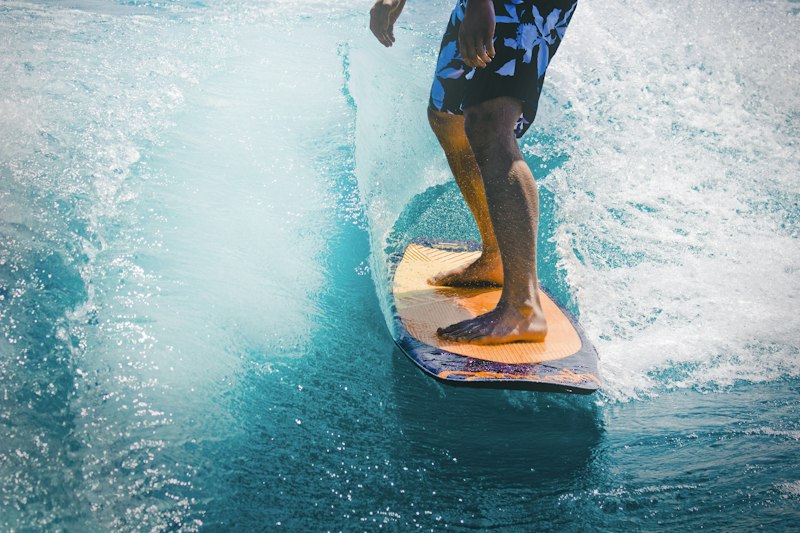
Inside Keoki Makana's shaping bay in Haleiwa, the air smells like foam dust and epoxy resin. Surfboards in various stages of completion hang from ceiling racks—some still rough blanks, others waiting for their final glassing. But unlike most shaping bays on the North Shore, you won't find traditional polyurethane foam stacked in the corner. Keoki is a North Shore surfboard shaper who's chosen a different path. For the last decade, he's built his reputation on sustainable surfboard design—using plant-based resins, recycled foam, and locally-sourced materials to craft custom boards that perform as well as their conventional counterparts while leaving a gentler footprint on the ocean they're built to ride. "The irony isn't lost on me," he says, running his hand along a nearly-finished seven-foot shortboard. "We claim to love the ocean, then we shape our boards from petroleum products that'll sit in a landfill for 500 years. That doesn't add up."
Finding the Path
Keoki didn't start as an environmentalist. He started as a grom who just wanted to ride waves. Growing up in Waialua, he spent every available hour in the water at Haleiwa and Sunset Beach. At 15, he bought a damaged board cheap and tried to repair it in his parents' garage. The repair failed spectacularly—but the process hooked him.
"I realized I could make my own boards. That I didn't have to save up $800 every time I wanted to try a different shape. So I started shaping." He apprenticed under an old-school shaper in Haleiwa, learned the traditional methods, built boards the way everyone had built them since the 1950s: polyurethane foam blanks, polyester resin, fiberglass cloth. Standard industry materials. Petroleum-based, toxic, non-biodegradable.
The shift came gradually. A surf trip to Indonesia in his mid-twenties showed him reefs choked with plastic, beaches buried in trash. "I was riding waves in paradise while literally dodging garbage in the lineup. It hit me that I was part of the problem. Every board I shaped added to that." Back home, he started researching alternatives. What he found was promising but complicated.
Rethinking Materials: Beyond Petroleum
Walk through Keoki's workshop today, and the materials tell a different story than conventional shaping bays. Instead of polyurethane foam, he uses blanks made from expanded polystyrene (EPS) recycled from post-consumer waste, or newer bio-based foams made from algae and plant oils. The resin isn't the standard petroleum-based polyester—it's bio-epoxy derived from plant sources like pine tree sap and cashew nut shells.
"The technology exists," Keoki explains. "Bio-resins perform just as well as conventional epoxy. They're lighter, stronger, and they break down in decades instead of centuries. The challenge isn't performance—it's availability and cost."
Traditional polyurethane foam costs about $40-60 per blank. Recycled EPS or bio-foam runs $80-120. Bio-epoxy resin costs roughly 30-50% more than standard polyester. These price differences add up quickly when you're shaping professionally.
"I had to make a choice. I could keep my prices competitive using cheap materials, or I could raise them and explain to customers why sustainable boards cost more. I chose education." Most of his clients, he says, understand once they learn the trade-offs. A board that costs $900 instead of $700 but lasts longer and doesn't pollute the ocean? Most North Shore surfers will pay that premium.
Then there's the matter of supply chains. Major foam manufacturers still primarily produce petroleum-based materials. Sustainable alternatives often come from smaller companies with limited production capacity and inconsistent quality control. Keoki has learned to work with multiple suppliers, testing each batch of foam and resin before committing to large orders.
"Sometimes I get a bio-foam blank that shapes like butter. Other times it's temperamental—tears instead of cuts clean, density varies across the blank. You adapt. That's what shapers do."

The Shaping Process: Where Craft Meets Conscience
The actual shaping process hasn't changed much. Keoki still uses a planer to rough out the outline, still hand-sands rails to get the feel right, still eyeballs the rocker from nose to tail. "Shaping is an art form. The tools and techniques are mostly the same whether you're working with polyurethane or bio-foam. But the details matter."
EPS foam, for example, requires different techniques than traditional polyurethane. It's more delicate, less forgiving of aggressive planing. Keoki learned to adjust his touch—lighter pressure, more passes, patience. "With polyurethane, you can muscle through mistakes. With EPS, you need finesse. It made me a better shaper."
He also pays attention to waste. Traditional shaping bays generate massive amounts of foam dust and resin-soaked cloth scraps—most of which ends up in landfills. Keoki installed a dust collection system that captures 95% of foam particles, which he then compresses and returns to his foam supplier for recycling. Resin containers get cleaned and reused. Fiberglass scraps go to a local artist who incorporates them into sculptures.
"Zero waste is impossible in this industry. But I can get close. Every pound of foam I don't throw away is a pound that doesn't end up in the ocean or a landfill."
The finishing process gets similar scrutiny. Traditional surfboard glosses contain high levels of volatile organic compounds (VOCs) that evaporate into the air and contribute to both air pollution and shaper health problems. Keoki switched to low-VOC finishes and water-based polishes. "The fumes in old-school shaping bays are gnarly. I wanted to protect my lungs and the environment."
Challenges: When Sustainability Meets Reality
Ask Keoki about the biggest challenges of sustainable shaping, and he doesn't hesitate: "Convincing people it's not just hippie bullshit."
There's a perception in surf culture that eco-friendly equals inferior performance. That sustainable boards are softer, slower, less responsive than conventional shapes. Keoki has spent years proving otherwise—putting his boards under pro surfers, entering them in competitions, documenting their durability.
"I've had clients ride my boards for five years with zero structural issues. I've had team riders take them to Pipeline, Sunset, places where boards get punished. They hold up. The performance is there. But I still get guys who assume bio-resin means 'weaker.' Education is ongoing."
The economics present another challenge. A one-person shaping operation can't compete on price with factory-produced boards made overseas using the cheapest possible materials and labor. Keoki's boards take longer to make, cost more in raw materials, and sell in smaller volumes.
"I'll never be rich doing this. But I sleep better knowing I'm not contributing to ocean pollution just to make a buck. And I'm building boards that align with the lifestyle surfers claim to value—respect for the ocean, connection to nature, sustainability."
Then there's the supply chain fragility. When COVID-19 disrupted shipping, Keoki's access to bio-resin became unpredictable. Shipments delayed for months. Quality inconsistency. Price spikes. "It exposed how dependent I am on specialized suppliers. That's pushing me to explore even more localized solutions—resins made in Hawaii, foam from regional recycling programs. The closer the supply chain, the more resilient."
Advice for Buyers: Choosing Sustainable Boards
For surfers considering sustainable boards, Keoki offers clear guidance:
Ask Questions: Don't assume "eco-friendly" means anything specific. Ask shapers exactly what materials they use. Bio-resin? Recycled foam? What percentage of the board is sustainable? Some boards market themselves as eco-friendly but only use sustainable materials for 20-30% of construction.
Understand Trade-offs: Sustainable doesn't always mean perfect. Some bio-foams are slightly heavier than polyurethane. Some bio-resins yellow faster in sunlight. These are minor trade-offs for most surfers, but they're worth knowing.
Support Local Shapers: Mass-produced boards shipped from overseas have massive carbon footprints before they ever hit the water. A custom board from a local shaper—even if not using sustainable materials—has a smaller environmental impact than a factory board shipped 5,000 miles.
Maintain Your Board: The most sustainable board is the one you already own. Repair dings promptly, rinse after sessions, store out of direct sun. A well-maintained board can last a decade. A neglected one might last two years.
Consider Lifespan: A $900 sustainable board that lasts seven years costs less per session than a $500 conventional board that lasts three years and ends up in a landfill. Calculate cost-per-wave, not just upfront price.
The Future: Where Sustainable Shaping Is Headed
Keoki is cautiously optimistic about the future of sustainable surfboard construction. Major brands like Firewire and Notox have invested heavily in eco-friendly materials and manufacturing processes. Technology continues improving—newer bio-foams perform better than versions from even five years ago. Consumer awareness grows as younger surfers demand products that align with environmental values.
"Ten years ago, I was one of maybe three shapers on the North Shore using bio-resins. Now there are dozens. That's progress." But he's quick to note that sustainable shaping remains a niche market. The majority of surfboards worldwide still use conventional petroleum-based materials.
The next frontier, Keoki believes, is fully circular production—boards designed from the outset to be recycled or composted at end-of-life. "Right now, even sustainable boards eventually become waste. Imagine boards made from materials that decompose naturally or can be broken down and reformed into new boards. That's the goal."
He's also experimenting with alternative fibers—flax, hemp, basalt—to replace fiberglass. "These materials grow fast, require minimal processing, and perform surprisingly well. We're still figuring out the best layup techniques, but early results are promising."
Craftsmanship and Responsibility
As we finish the conversation, Keoki steps back to examine the board he's been shaping. In a few days, it'll get glassed with bio-epoxy, sanded smooth, and sent to a surfer who ordered it six weeks ago. The surfer will paddle out at Haleiwa or Sunset, catch waves, feel the ocean beneath them. And the board beneath them will eventually return to the earth instead of polluting it.
"Shaping boards is about problem-solving," Keoki says. "You're trying to solve hydrodynamics, buoyancy, flex patterns. But those aren't the only problems worth solving. We also need to solve the problem of how to make surfboards without destroying the ocean they're meant to honor. That's a challenge worth accepting."